- Q1. How do I use it?
- Q2. Is there a vocabulary list?
- Q3. Won’t learners be able to guess the answer from the reader’s eye movements?
- Q4. What is the relationship between the front and back of each card?
- Q5. Is it effective for learners from kanji-based language backgrounds?
- Q6. Can it be used with adult learners?
- Q7. My main goal is to develop conversation skills, and my learners have mixed levels. I feel that karuta might be too difficult.
- Q8. Wouldn’t it be easier to learn if each word had its own illustration?
- Q9. Why use karuta for JLPT preparation?
Q1. How do I use it?
A1. Here is a suggested basic way to use one set (100 cards / 200 words).
For a class of 20 students, one set is sufficient. Divide the class into four groups of five students. Each group uses 25 cards, placed face up in the center.
Choose one student in each group as the reader, who will read the cards aloud. The teacher can monitor and support as needed, but the activity should encourage learner autonomy.
Make sure that all students have the opportunity to take turns as the reader.
Q2. Is there a vocabulary list?
A2. Yes, of course.
However, checking the vocabulary list each time can be time-consuming. We recommend simply reading the cards in front of you at random during the activity.
Q3. Won’t learners be able to guess the answer from the reader’s eye movements?
A3. Once you have chosen a card, try not to fix your gaze on it—let your eyes move naturally. This makes it much harder for others to guess.
It may take a little practice, but when learners take on the role of the reader, they temporarily memorize the vocabulary, which also makes the activity an effective learning experience.
Q4. What is the relationship between the front and back of each card?
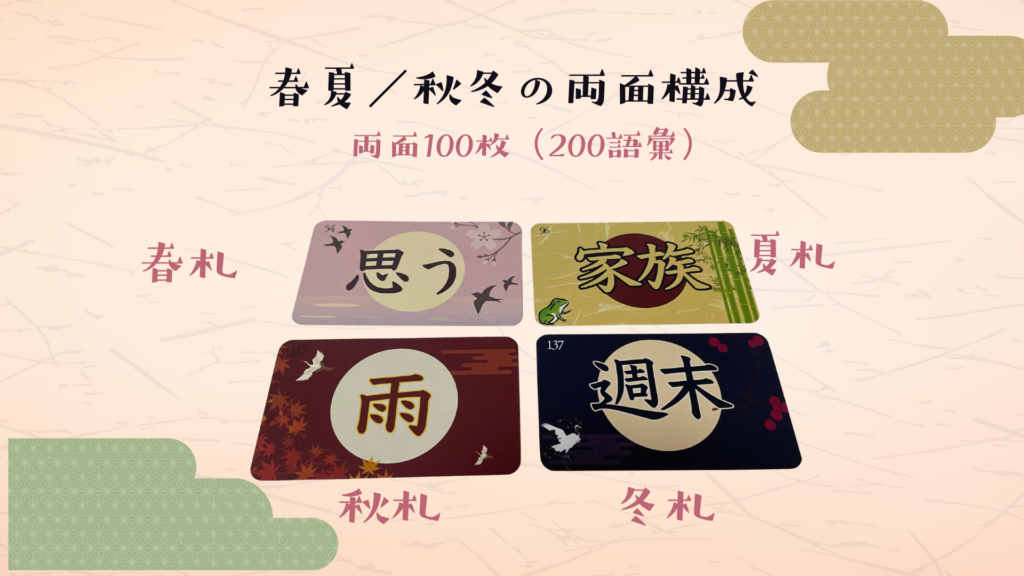
A4. The front and back are designed with pairs such as antonyms or related words.
This allows for a variety of ways to play and learn. For example, learners can try to guess what is written on the back of a card after picking it, or create short sentences by connecting the words on the front and back.
Another activity is to have a group focus on one card and take turns creating sentences. To make it more engaging, each student must come up with a different sentence. Adding a time limit with a stopwatch can make the activity more dynamic.
We also encourage you to explore and discover your own creative ways to use the cards. This flexibility is one of the key strengths of Kotonoha Karuta.
Q5. Is it effective for learners from kanji-based language backgrounds?
A5. Yes, absolutely.
Learners from kanji-based language backgrounds often recognize the characters, but many struggle with pronunciation. In fact, it is quite common for them to find it difficult to remember how to read the kanji.
When using this activity, even typically quiet learners can become much more engaged and active. Although the characters may be familiar, reading them correctly can still be challenging. This often sparks a strong sense of motivation and friendly competition.
It also creates moments where these learners can stand out and gain recognition within the class. When you introduce team-based activities—such as grouping learners with kanji backgrounds and those without—the energy in the classroom increases, and a strong sense of unity emerges. This makes it an especially effective tool for mixed-level and multicultural classrooms.
Q6. Can it be used with adult learners?
A6. Yes, absolutely.
In fact, it was not originally designed specifically for children (although children can certainly enjoy it as well).
The illustrations on the cards are not merely decorative—they are designed to support deeper recognition and understanding of vocabulary. They are not intended simply to help young learners become familiar with written characters.
In practice, classes with adult learners can become highly engaging and lively. Even among adults meeting for the first time, the activity naturally encourages interaction and conversation, making it an excellent icebreaker.
When it comes to grabbing the cards, adults often become surprisingly competitive. It taps into a shared human instinct, and witnessing that moment of engagement is one of the true joys of teaching.
This makes it ideal for both classroom use and community-based learning settings.
Q7. My main goal is to develop conversation skills, and my learners have mixed levels. I feel that karuta might be too difficult.
A7. One of the key strengths of this karuta is that it naturally generates conversation through the words on the cards.
Rather than relying on teacher-assigned situations, learners are inspired by the words they happen to pick up, which encourages them to speak about what they already know. Those who know more can naturally support those who know less, creating spontaneous information gaps that lead to meaningful communication.
In mixed-level classes, there is no need to focus on competition. Simply looking at the cards and sharing what each learner knows can organically develop conversation. Even learners who are usually quiet may begin to speak when prompted by a card. Being able to witness that moment is one of the unique values of this karuta.
For learners living in Japan, increasing the number of words and kanji they can understand directly improves their quality of life. For those interested in Japanese culture, it also deepens their understanding and engagement with the language.
We hope this tool will support activities that enhance both the quality and value of language learning.
This makes it especially effective in communicative and learner-centered classrooms.
Q8. Wouldn’t it be easier to learn if each word had its own illustration?
A8. We intentionally chose not to include individual illustrations for each word.
Young children often grab a card after hearing just the first sound—not because they recognize the written word, but because they remember the picture. In other words, they rely on visual cues rather than truly reading.
Kanji themselves originated as pictographs. For this reason, we want learners to recognize and remember the characters themselves, rather than relying on additional images.
That said, each card includes a small, shared illustration in the corner—for example, a frog for summer-themed cards or an onigiri for hiragana cards. These serve as subtle visual guides, like training wheels, to support learners who may still feel unsure about orientation (such as top and bottom).
If you are familiar with Japanese, try imagining what it feels like to read unfamiliar scripts such as Thai or Arabic.
This may help you understand how learners feel. For them, kanji and kana can also be challenging in terms of visual orientation.
As a result, this design encourages learners to engage more directly with the written language itself.
Q9. Why use karuta for JLPT preparation?
A9. Through teaching reading comprehension, we have noticed an important pattern.
When key words are pointed out in a passage, learners often go back and reread from the beginning. Words that native speakers can identify instantly do not always stand out to learners.
So how can learners quickly find key words among many kanji?
Improving reading speed requires the ability to recognize important words at a glance.
Karuta is an effective way to train this skill.
This makes it a practical and engaging tool for JLPT preparation.